
Bookkeeper business cards and design ideas
Bookkeeper marketing should make accurate recurring bookkeeping support easy to understand, credible, and simple to act on for busy small-business owners. This guide combines practical campaign planning with editable prompt recipes and visual examples, so you can move from an idea to a usable business card without starting from a blank canvas.

Marketing analysis
What the design needs to achieve
Help busy small-business owners understand accurate recurring bookkeeping support, trust the business, and take one clear next step. For bookkeeping businesses, the strongest campaigns focus on generate enquiries for accurate recurring bookkeeping support, promote books health check, build recognisable local trust. The design should help busy small-business owners, new local customers comparing accurate recurring bookkeeping support, past customers ready to return or refer understand the offer, recognise why the business is credible, and take the next step without searching for essential details.
- ✓software experience and clear service process
- ✓real contact and service-area details
- ✓truthful proof that matches the business
Why business cards
Use the format intentionally
Business card design is particularly useful here because it supports personal introductions, referral prompts, appointment reminders, contact sharing. Prioritise one campaign goal, one visual hierarchy, and one response action. Recommended starting formats include 3.5 × 2 in, 85 × 55 mm, Horizontal, Vertical.
Prompt → design examples
Campaign directions you can adapt
Each example connects a clear marketing goal to a structured prompt. Replace the sample offer and details with information that is true for your business.
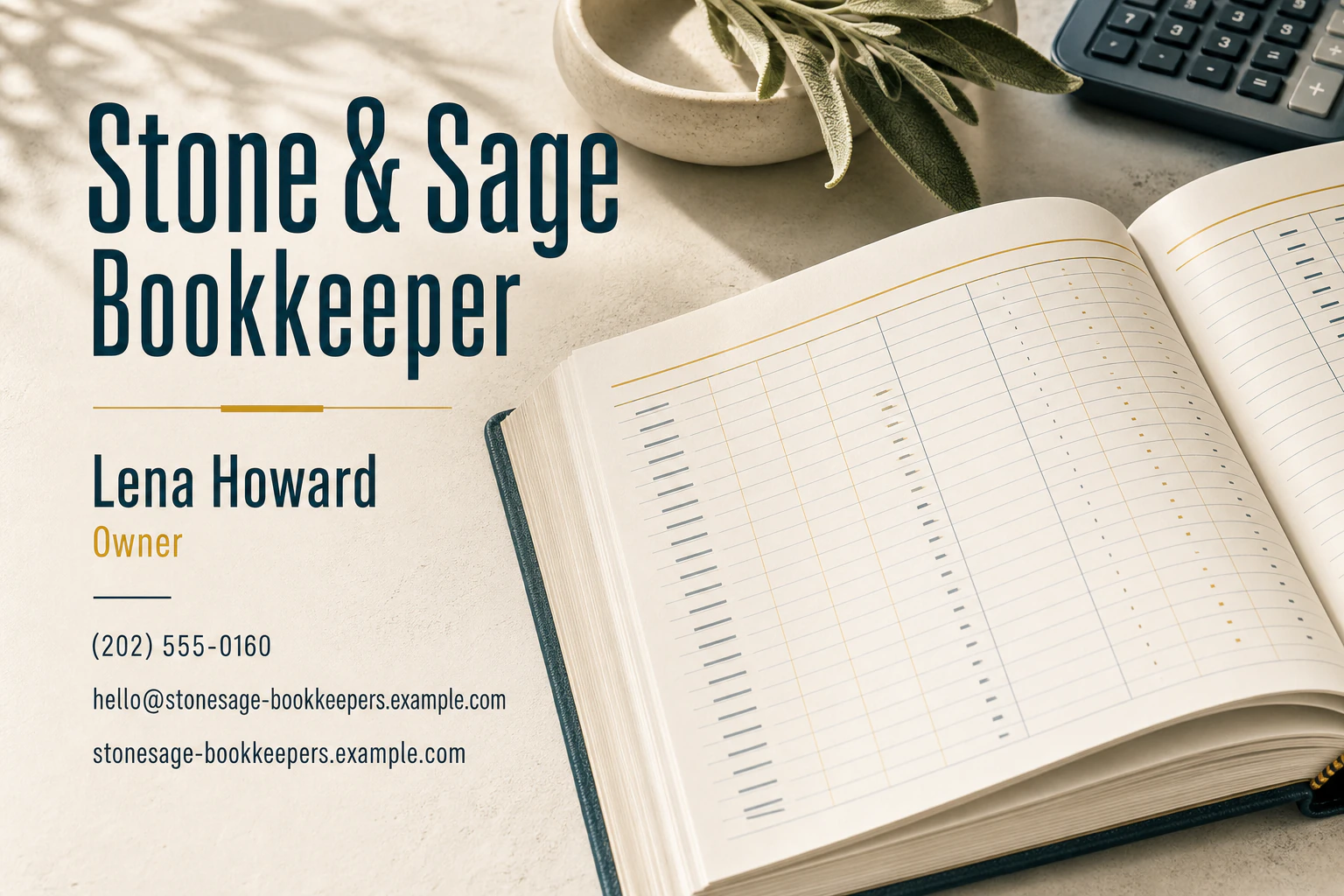
The Ledger That Finally Lands
Offer-and-response-led: this direction turns the books health check into a tangible moment of relief. A busy owner immediately recognises the satisfying visual result—one orderly, reconciled ledger—rather than being asked to decode generic accounting imagery.
Prompt
Create a simple business card for a local bookkeeper, featuring books health check. Use cream and navy blue in a clear, easy-to-edit layout that makes the finished result the main visual. Add a name, role, phone number, email, and website, and keep it a contact card rather than an ad.
The Quiet Grid of Every Month
Brand-and-trust-led: this direction communicates the service's real value as a sustained, repeatable operating system. It is designed to feel established and locally dependable at first glance, giving returning customers and referrers a clear memory structure without resorting to claims, badges, or generic financial symbolism.
Prompt
Create a simple business card for a local bookkeeper, featuring seasonal accurate recurring bookkeeping support reminder. Use beige and red in a clear, easy-to-edit layout that makes the finished result the main visual. Add a name, role, phone number, email, and website, and keep it a contact card rather than an ad.
Interactive prompt builder
Build your own starting brief
Change the campaign details, copy the result, or send it directly to AI Marketing Designer.
Generated brief
Create a polished business card for a local bookkeeper. Campaign goal: generate enquiries for accurate recurring bookkeeping support. Audience: busy small-business owners. Offer: books health check. Visual direction: organised workspace, friendly professional portrait, and fresh teal. Include a strong headline, software experience and clear service process and real contact and service-area details, and one clear call to action. Format: 3.5 × 2 in. Keep all text readable and leave room for real business details.
Copy ideas
Headlines and calls to action
A better way to enquiries for accurate recurring bookkeeping support
Books health check — made simple
Local bookkeeper, clear next step
Seasonal accurate recurring bookkeeping support reminder for new local customers comparing accurate recurring bookkeeping support
Quality checklist
Mistakes to avoid
- !Using generic imagery or vague claims instead of showing software experience and clear service process and one focused offer.
- !Trying to speak to every possible audience instead of prioritising busy small-business owners.
- !Using decorative elements that compete with software experience and clear service process and the main call to action.
- !Publishing placeholder contact information or an offer without clear terms.